
 Long haul flights are an engineering marvel!
With Nick’s recent return home for a holiday, we began thinking about those long haul flights. Did you know that a Boeing 787’s wingtips can flex more than 7 metres upwards during turbulence or take-off. Interestingly, rather than storing fuel in the fuselage, most long-haul aircraft keep it inside the wings. This reduces stress on the wing structure and improves balance throughout the flight.
Each engine on a Boeing 787 generates around 70,000 pounds of thrust. That’s roughly equivalent to 70 Formula 1 cars at full throttle. Its engine is also incredibly efficient. Modern turbofan engines move far more air around the engine than through it. About 90% of the thrust actually comes from the huge front fan rather than the combustion core.
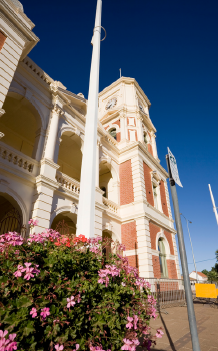 Kalgoorlie – an Engineering Marvel
 Wombats – the rural traffic officers!
 Can you compete with an octopus?
 Vending Machines of Japan
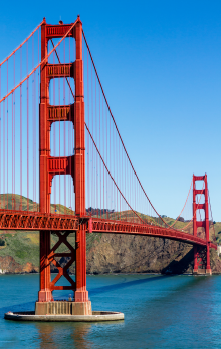 The Golden Gate Bridge
 That’s not cricket!
 Counting down with chocolate!
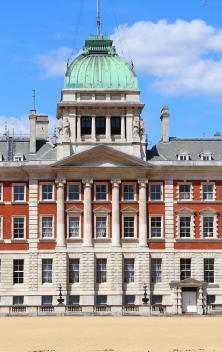 Working in an office – a tale as old as time (almost!)
 Unpacking a new office!
 Looking forward to a new office!
Texcel is in the process of relocating from Northgate to Murarrie!
Did you know that the average small business uses 40-60 boxes to move? And,the average cardboard moving box can usually be used 3-10 times before it’s no longer structurally sound.
The most common time to move is in summer since most people perceive that they have more time in summer. And as you might expect, winter is the cheapest time to move.
You also probably won’t be surprised to learn that Friday is the most popular day to move since it gives you an extra couple of days of the weekend to settle!
 Why do we drive on the left?
Ever wondered why some countries drive on the left and some on the right-hand side of the road?
It turns out that this dates all the way back to the time of knights when riders rode on the left so that swordsmen had their weapon closest to their opponent and their scabbard on the left where it was not in their way when mounting their horse.
While some speculate that Americans switched to the right purely out of spite for the British, it turns out that this was most likely an evolution of farming. When the US began mass farming, wagons that were drawn by four horses were used to haul large farm products.
 Why do we enjoy a roller coaster?
Why are roller coasters so popular?
It is thought that the earliest roller coasters can be traced back to ice slides in Russia in the 16 and 17 centuries which became popular with the healthy population. A summer version was later created by Catherine the Great involving wheeled carts. In the early 19 century, the idea spread to France where the first wheeled coaster on a track opened in 1817. The first American roller coaster was built in the US in the mid-1800’s as a scenic ride for tourists. These days, it is estimated that there are approximately 3,364 roller coasters in the World.
But what is the appeal to humans?
 Isn’t that ironic?
Did you know that the word “oxymoron” is itself an oxymoron?
The term oxymoron refers to a figure of speech in which condradictory terms appear in conjunction with each other such as “deafening silence” or “awfully good”. It is thought that by pairing these words the writer creates “tension” or a sense of irony.
However, the word “oxymoron” is taken from two Ancient Greek words “oxy” meaning sharp and “moron” meaning stupid!
 We’re a multicultural crew!
As we welcomed our newest team member Tatenda (originally from Zimbabwe) , we got to thinking about multiculturalism in Australia. Did you know that around 50% of our population were either born overseas or have a parent who was born overseas?
About 1 in every 5 people speak a language other than English at home and collectively Australia is home to over 200 languages! You might be surprised to know that the single most common language other than English is in fact . . . Italian!! Ciao Bella!
Unsurprisingly, it was the discovery of gold in the 1850’s which led to Australia’sfirst rush of migration from overseas!
 Keeping it cool – air conditioning!
Named as one of Time Magazine’s 100 most influential people in 1998, Willis Carrier was the first to “solve the puzzle of controlling the indoor environment” with his invention of air conditioning in 1902 (Source: carrier.com).
Despite the incredible heat in Australia, air conditioning only became common in households in the last 20 years. Now – it’s hard to imagine a time without it!
Willis Carrier was in fact trying to solve the puzzle of controlling the humidity in a printing plant in Brooklyn, New York. But
this game changing technology ultimately changed the way we live – how food is produced, where and how we shop, socialise and work and even our daily commute!
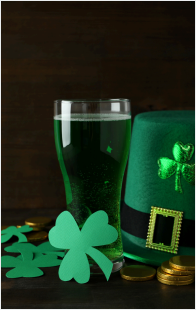 St Patrick’s Day
In honour of the March fun of St Patrick’s Day, we thought we would entertain you with a few fun facts about the Irish holiday.
Did you know that St Patrick (the patron saint of Ireland) was not actually born in Ireland? It turns out that he was born in Roman Britain and was kidnapped by Irish raiders and sold into slavery in Ireland when he was just 16 years old! His original name was Maewyn Succat.
You may also be unaware that the first St Patrick’s Day parade actually took place in the USA and not Ireland (it was held in Florida in 1601). At this time, the colour associated with the day was actually blue but was later changed to green due to the colour of Ireland’s landscape!
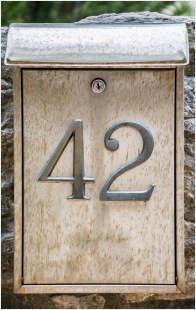 The number 42!
 This is the 42nd edition of our Tech Simply newsletter. As you’re probably aware, Douglas Adam’s popular science-fiction novel The Hitchhiker’s Guide to the Galaxy revealed that the answer to the “Great question of Life, the Universe and Everything” is 42. So we pondered? What is the significance of 42?
Jean-Paul Delahaye pondered this question in an article in Scientific American in 2020: In ancient Egyptian mythology, the number 42 represents the number of judges that a deceased person would face during the judgement of their soul in the afterlife where they had to declare their innocence against 42 specific sins.
A marathon is 42.194km which corresponds with the distance the Greek messenger Pheidippides traveled between Marathon & Athens to pass a message of victory.
 Red for Chinese New Year
With Chinese New Year currently in fully swing and over 2 billion people around the world celebrating the holiday, did you know the significance of the colour red?
According to Chinese legend a mythical beast named “Nian” would devour villagers on New Years Eve but he was scared away by the colour red and loud noises. By wearing red and celebrating with fireworks people were able to ward off evil spirits and bring positive energy for the new year. Culturally red represents fire and energy and is a symbol of vitality, celebration and good fortune.
 A decorated tree?
Why do people bring trees inside and decorate them at this time of year? It’s an odd tradition!
It is understood that this tradition started with ancient Romans who believed that trees signaled the “return of life” after a long winter. It is thought that they brought them inside as part of their celebration of the winter solstice (the shortest day of the year). Early decorations of these trees included nuts and fruit to represent fertility and abundance.
During the 16th century, Germans were thought to be the first to decorate these trees with lights.
 Storms Ahead!
Did you know that about 2,000 thunderstorms rain down on Earth every minute? In fact, Australia experiences between 40 and 40.5
million lightning strikes in November which is typically our most stormy month.
Surprisingly, only about 100 people per year are injured by lightning strikes in Australia with most of these occurring due to indirect strikes, which occur when the ground becomes electrified after a lightning strike.
You’re more likely to be struck by lightning in Australia the further north you go so be careful up north!
 Stingy Jack – now a Jack-o’-Lantern
Have you ever wondered where the carving of a Jack-o’-Lantern at Halloween originated?
Legend has it that a drunkard known as Stingy Jack once came across Satan who had come to collect his soul. Jack made one last request and asked if he could drink ale before he departed. Satan agreed and after drinking, Jack asked the devil to pay knowing that Satan did not carry any money. He convinced the devil to turn himself into a silver coin to pay the bartender and told him that he could change back afterwards. He then tricked the devil and pocketed the coin along with a silver crucifix. The presence of the cross prevented the devil from escaping his form.
 Wattle – our National Blossom!
Did you know that 1 September was National Wattle Day?
First celebrated in 1910, Wattle is thought to symbolise optimism, resilience, renewal, diversity and unity. During the World Wars wattle became a symbol of home for military personnel serving overseas, and as a means of raising money for organisations such as the Red Cross. Wattle Day badges as well as wattle sprigs were sold.
You also may not know that Australia’s national colours of green and gold were chosen in April 1984 as they represented wattle’s green leaves and gold blossom.
 Are all fruits vegan?
You may have thought that all fruits are considered vegan but did you know that some figs are actually not vegan-friendly?
While figs are usually considered a fruit, they are actually inverted flowers and their buds bloom inside their pods. Pollination occurs when
a female wasp crawls inside the fig but she unable to back out again due to the size of the opening, so she lays her eggs inside before she dies. When the eggs hatch the wingless males help the winged females to escape by creating tunnels for them. After the remaining wasps have all died, the enzymes inside the fig dissolve the insect.
 Inventing the moving staircase
Have you ever thought about that moving staircase that you ride on each day? Did you know that the first patent related to an escalator was granted in 1859? A second patent was granted for an “inclined elevator” in 1892 and this one was originally intended as a novelty ride at Coney Island in New York! The modern escalator that we are more familiar with was re-designed in 1897 by Charles Seeberger who partnered with Otis Elevator Co to produce the first commercial escalator in 1899.
Escalators were intended to move larger numbers of people more efficiently than elevators but with the same space occupancy as a staircase.
 Hoping for a white winter?
Thinking about skiing over the winter? Did you know that the word “ski” comes from the Norwegian word skio which translates into “piece of wood”? The Norwegians are so into skiing that they were the first country to introduce a specialised ski unit in their army in 1721! Be careful with your knees – about 35% of skiing accidents result in some form of knee injury (although interestingly skiers typically have fewer injuries
than football players).
And in case you needed any more motivation – did you know that moderate downhill skiing burns around 400 calories per hour?
 The Power of a Good Book
As the weather cools down and some of you may be dreaming of just curling under a blanket to read a good book . . . did you know that the
most expensive book ever purchased was Codex Leicester by Leonardo Da Vinci which was purchased by Bill Gates for USD30.8 million in 1994!
And if you want an excuse to just sit and read for a while, did you know that the longest sentence ever published is from Jonathan Coe’s book The Rotter’s Club which contains over 13,955 words. In case you’re curious, the longest word contains 189,819 letters as in the name of a giant protein!
 Did April Fool You?
Love it or hate it, April Fools’ Day has been around for a very long time. Some say it began in Ancient Rome where the festival of Hilaria was held on March 25 where people dressed up in disguises to mock others – this may have eventually moved to April 1st.
Others say it began in France in 1564 when the country moved from the Julian calendar to the Gregorian calendar with the new year moving from April 1st to January 1st. People who were slow to get the news or continued to celebrate it in April were known as “April Fools” and often found themselves as the butt of jokes and hoaxes.
 Thinking about a snooze?
 With daylight saving about to end, it got us to thinking about sleep . . .
You might think that sleep time is wasted time but did you know that the average person burns around 400 calories every night while they’re asleep! And interestingly, cats sleep approximately 16 hours per day while elephants in the wild typically sleep only 2 hours a night.
You’ve all heard the message that you should stay away from your electronic devices before bed but it’s amazing to think about some of the impacts of technology on our sleep. Did you know that approximately 12% of people dream in only black and white? Before the
invention of colour television, this percentage was roughly 65%. Who knew technology impacted our sleep even back
then?!
 Leaping into 2024!
What’s with Leap Years? It takes the Earth 365 days, 5 hours, 48 minutes and 45 seconds to circle once around the sun. Since our calendar only has 365 days we need to add an extra day to our shortest month every four years or we would find ourselves off by about 24 days every century! We would be losing almost 6 hours every year!
And did you know that technically, it’s not every four years? There’s actually a leap year every year that is divisible by four but century years must also be divisible by 400. The year 2000 was a leap year but the years 1700, 1800 and 1900 were not!
So what will you do with the extra 1,440 minutes this leap year?
 Happy New Year!
However you bring in the New Year, there seems to be a whole lot of superstition around the world regarding particular actions that bring good luck for the year ahead. Have you ever thought about some of the more unusual practices?